
19 Affordable Alternatives to Hiring a Full-Time Marketer: Compared and Reviewed
Hiring a full-time marketing professional can cost anywhere from $50,000 to $100,000 annually, plus benefits, equipment, and training. For small businesses and startups, that’s often an impossible investment. The good news is that you have plenty of other options, each with different strengths, weaknesses, and price points. This list compares 19 alternatives so you can see how they stack up against each other and find the right fit for your budget, timeline, and marketing needs.
- Legiit: Freelance Marketplace for Marketing Services

Legiit connects you with freelance marketers who specialize in everything from SEO and content writing to social media management and email campaigns. Compared to hiring in-house, you pay only for the services you need, when you need them, without long-term commitments or benefits packages.
The platform offers fixed-price services, which makes budgeting straightforward. You know exactly what you’ll pay before you commit. This transparency stands in contrast to hourly freelancers, where costs can spiral if a project takes longer than expected.
One advantage over general freelance sites is that Legiit focuses specifically on digital marketing and related services. This means less time sorting through unrelated profiles and more time finding someone who actually understands your marketing challenges. The trade-off is a smaller talent pool than massive platforms, but the specialization often means higher quality matches for marketing work.
- General Freelance Platforms vs. Specialized Marketing Sites
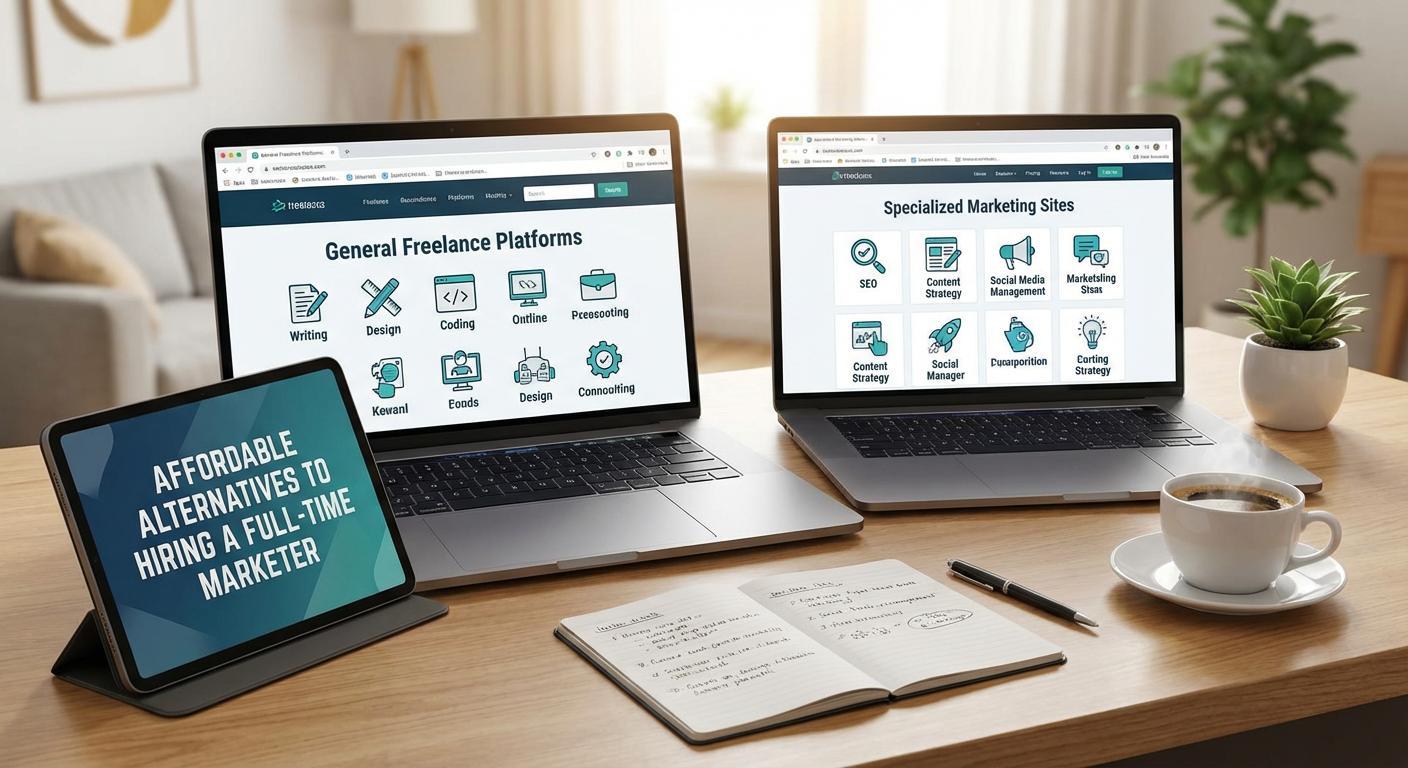
Sites like Upwork and Fiverr offer access to millions of freelancers across every skill imaginable. The benefit is choice and competitive pricing, especially for one-off tasks. The downside is that you’ll spend significant time vetting candidates, and quality varies wildly.
Specialized marketing platforms tend to pre-screen their talent or focus on specific niches, which saves you time but may cost slightly more per project. If you need a quick graphic or blog post and have time to vet applicants, general platforms work well. If you need strategic marketing help and want less risk, specialized sites offer better odds of finding someone who knows what they’re doing.
Consider your own experience level too. If you can evaluate marketing work confidently, general platforms give you more bargaining power. If you’re less sure what good marketing looks like, a curated marketplace reduces your risk of hiring someone who talks a good game but delivers poor results.
- Marketing Agencies vs. Solo Freelancers
Agencies bring teams, processes, and accountability. When you hire an agency, you typically get a project manager, strategists, and specialists working together. This structure means faster turnaround and more comprehensive campaigns. The cost, however, is significantly higher than hiring individual freelancers, often starting at several thousand dollars per month.
Solo freelancers cost less and offer more direct communication. You work with one person who handles your account personally, which can mean more attention to detail and a closer working relationship. The limitation is capacity. A single freelancer can only do so much, and if they get sick or overbooked, your work stops.
The choice depends on your project scope. For a complete marketing overhaul or ongoing multichannel campaigns, an agency’s resources justify the premium. For focused tasks like managing your Instagram or writing weekly blog posts, a skilled freelancer delivers excellent value without the agency markup.
- Marketing Automation Software vs. Human Management
Tools like Mailchimp, HubSpot, and Buffer let you automate email campaigns, social media posting, and lead nurturing without paying someone to do it manually. The upside is consistency and cost savings. Once set up, these systems run with minimal intervention. The price ranges from free tiers to a few hundred dollars monthly, far less than a salary.
The trade-off is that software can’t think strategically. It won’t adjust your messaging based on subtle market shifts or create compelling content from scratch. You still need human input to set up campaigns, write copy, design graphics, and analyze results. Automation handles execution, not strategy.
For best results, combine the two. Use automation to handle repetitive tasks like scheduling posts or sending welcome emails, then hire freelancers or consultants to create the content and strategy that feeds into those systems. This hybrid approach maximizes efficiency while keeping costs manageable.
- Marketing Consultants vs. Hands-On Executors
Consultants charge premium hourly rates, often $100 to $300 per hour, but they focus on strategy rather than execution. They’ll audit your current marketing, identify gaps, and create a roadmap for improvement. What they won’t do is write your blog posts, manage your ads, or design your graphics.
Executors like freelance writers, designers, and social media managers charge less per hour but require clear direction. They do the work you assign but may not question whether it’s the right work. If your strategy is sound, executors offer better value. If you’re not sure what you should be doing, a consultant’s expertise pays off.
Many businesses benefit from a consultant engagement first to build a solid plan, then hiring lower-cost executors to implement it. This two-phase approach costs more upfront but prevents wasting money on tactics that don’t align with your goals. Compare this to hiring executors without strategy, which often leads to scattered efforts and mediocre results.
- Virtual Assistants vs. Marketing Specialists
Virtual assistants handle administrative marketing tasks like scheduling social posts, monitoring comments, formatting newsletters, and updating your website. They cost significantly less than marketing specialists, typically $15 to $40 per hour, and can free up your time for higher-level work.
Marketing specialists bring expertise in specific channels or tactics. An SEO specialist understands keyword research and technical optimization. A copywriter knows how to write persuasive sales pages. They charge more, usually $50 to $150 per hour, but deliver work that directly impacts revenue.
The decision hinges on task complexity. Posting pre-written content to Facebook? A VA handles that perfectly. Developing an SEO content strategy? You need a specialist. Many businesses use VAs for routine execution and bring in specialists for strategy and complex projects. This tiered approach balances cost with expertise where it matters most.
- Content Mills vs. Quality Content Writers
Content mills churn out blog posts, articles, and web copy at rock-bottom prices, sometimes $20 for a 1,000-word article. Speed and volume are their strengths. Quality and originality are not. The writing is often generic, poorly researched, and requires heavy editing. For businesses that need lots of content fast and have someone to polish it, mills offer a starting point.
Professional content writers charge $100 to $500 per article but deliver work that engages readers, ranks in search engines, and reflects your brand voice. They research your industry, interview subject matter experts if needed, and craft pieces that actually convert readers into customers.
The cost difference is real, but so is the return. A single well-written piece that ranks on Google’s first page can drive traffic and sales for years. Ten mediocre articles from a mill might generate little beyond filling space on your site. If content is central to your marketing strategy, invest in quality. If you need filler for a large site quickly, mills serve a purpose but with limited expectations.
- Done-For-You Services vs. DIY With Courses
Done-for-you services handle everything. You pay someone to build your email funnels, run your Facebook ads, or manage your SEO. Costs vary widely, from a few hundred to several thousand per month, but you get results without having to learn the skills yourself.
Online courses and training programs teach you to do the work in-house. A comprehensive marketing course might cost $200 to $2,000 as a one-time expense. The investment is lower, and you gain valuable skills. The downside is time. Learning takes weeks or months, and applying that knowledge requires ongoing effort that pulls you away from other business activities.
Compare your opportunity cost. If your time is better spent on product development, sales, or operations, paying for done-for-you services makes sense even at higher prices. If you have time to learn and enjoy marketing, courses offer long-term savings and self-sufficiency. Some entrepreneurs split the difference by taking courses to understand marketing fundamentals, then hiring help for execution.
- Retainer Agreements vs. Project-Based Hiring
Retainer agreements lock in a set number of hours or deliverables per month at a fixed price. This arrangement provides consistency and often comes with a discount compared to one-off projects. Your marketer prioritizes your work and becomes familiar with your brand, which improves quality over time.
Project-based hiring gives you flexibility. You pay only when you have work, with no ongoing commitment. This works well for businesses with irregular marketing needs or limited budgets. The trade-off is availability. Good marketers book up quickly, and you might wait weeks for them to have an opening.
Retainers make sense when you have consistent marketing needs and value reliability. Project-based hiring suits businesses with sporadic needs or those testing different marketers before committing. Price-wise, retainers typically offer 10-20% savings compared to ad-hoc project rates, but you pay whether you use all the hours or not.
- Offshore Freelancers vs. Local Talent
Hiring marketers from countries with lower costs of living can cut your expenses by 50-75%. A skilled social media manager in the Philippines or India might charge $10-20 per hour versus $50-100 for someone in the US or UK. For budget-conscious businesses, this difference is substantial.
The challenges include time zone differences, communication styles, and cultural nuances in marketing. A marketer who doesn’t natively understand your target audience might miss tone, idioms, or references that resonate. Turnaround times can stretch when you’re asleep during their working hours.
Local talent costs more but typically requires less oversight and better understands your market. They’re available during your business hours for calls and quick questions. For customer-facing content where voice and cultural fit matter greatly, local talent often justifies the premium. For technical tasks like setting up email sequences or formatting graphics, offshore freelancers deliver excellent value.
- Marketing Interns vs. Junior Freelancers
Interns work for low pay or college credit, bringing enthusiasm and current academic knowledge. They’re ideal for businesses that can provide mentorship and have straightforward tasks to delegate. The cost is minimal, sometimes just $15 per hour or even unpaid in some regions, though unpaid arrangements come with legal restrictions.
Junior freelancers have some professional experience but charge less than senior marketers, typically $25-50 per hour. They work independently without the supervision interns require and bring practical skills from previous clients. The gap in expertise compared to senior freelancers is real but narrowing.
Interns need more hand-holding and produce work that often requires revision. Junior freelancers hit the ground running faster but cost more. If you have time to teach and manage, interns offer incredible value and potential long-term hires. If you need someone who can execute with minimal guidance, junior freelancers strike a nice balance between cost and capability.
- All-In-One Marketing Platforms vs. Best-Of-Breed Tools
Platforms like HubSpot and Keap bundle email marketing, CRM, social scheduling, landing pages, and analytics into one subscription. Pricing starts around $50 monthly for basic plans and scales up quickly, but you get everything in one place with integrated data. The convenience factor is high, and you avoid juggling multiple logins and tools.
Best-of-breed tools mean choosing the top option for each function: Mailchimp for email, Hootsuite for social, Google Analytics for tracking, and so on. This approach often costs less overall and gives you more powerful features for each category. The downside is complexity. Data doesn’t flow automatically between tools, and you need to learn multiple interfaces.
For solopreneurs and very small teams, all-in-one platforms reduce headaches even if they cost slightly more. For growing businesses with specific needs, mixing specialized tools delivers better performance. Compare your tolerance for complexity against your budget and feature requirements. Neither approach is universally better, it depends on your technical comfort and marketing sophistication.
- Freelance Marketers vs. Marketing Students
Established freelancers have portfolios, testimonials, and proven track records. They know what works and can hit the ground running. Rates reflect this experience, usually starting at $50 per hour and climbing from there. You pay for reliability and results.
Marketing students are still learning but hungry to build their portfolios. Many will work for $15-25 per hour or even offer discounted rates for the chance to gain real-world experience. They bring current academic knowledge and familiarity with the latest tools and trends taught in classrooms.
The risk with students is inconsistency and limited practical experience. They might miss deadlines during exam periods or lack the judgment that comes from handling multiple clients. For low-stakes projects or when you can provide guidance, students offer tremendous value. For critical campaigns where mistakes are costly, experienced freelancers are worth the premium. Some businesses use students for routine tasks and reserve complex projects for seasoned pros.
- Niche Specialists vs. Generalist Marketers
Specialists focus exclusively on one channel or tactic: Google Ads, Amazon listings, LinkedIn outreach, or email conversion optimization. They charge premium rates, often $100-200 per hour, because their deep expertise delivers measurable results. When you need that specific skill, no one does it better.
Generalists handle multiple marketing functions competently. They might manage your social media, write blog posts, and coordinate email campaigns. Their rates are lower, typically $40-75 per hour, and they offer convenience. One person manages various needs, which simplifies communication and project management.
Specialists make sense when you’ve identified a specific channel that drives your business and want to maximize its performance. Generalists work better when you need coverage across multiple areas and don’t require world-class execution in any single one. Many businesses start with a generalist to handle diverse needs, then bring in specialists as specific channels prove their value and justify expert attention.
- Monthly Service Packages vs. Hourly Billing
Monthly packages bundle specific deliverables at a flat rate: ten social posts, two blog articles, and weekly reporting for $1,500, for example. This structure makes budgeting simple and ensures consistent output. You know what you’re getting and what it costs, with no surprise invoices.
Hourly billing charges for actual time spent. Rates vary by task and provider, typically $30-150 per hour. This flexibility means you pay only for work performed, which can cost less if your needs are minimal. The uncertainty comes when projects take longer than expected, inflating your bill.
Packages favor businesses with predictable, ongoing needs who value budget certainty. Hourly billing suits those with variable workloads or projects where scope is hard to define upfront. Price-wise, packages often offer slight discounts versus hourly rates because providers can plan their time better. Compare the math on your typical monthly needs. If you consistently need similar work, packages usually save money and reduce administrative hassle.
- Marketing Templates and Tools vs. Custom Creation
Template marketplaces sell pre-designed email campaigns, social media graphics, landing pages, and ad copy for $10-50 per item. You customize them with your branding and content, getting professional-looking materials at a fraction of custom costs. Tools like Canva and Unbounce provide drag-and-drop interfaces that make customization easy even without design skills.
Custom creation means hiring designers, copywriters, and developers to build everything from scratch. This approach costs hundreds or thousands per project but delivers materials perfectly tailored to your brand and message. Nothing looks like a template because it isn’t one.
Templates work beautifully for standard marketing needs: welcome email sequences, social post designs, basic landing pages. They’re fast, cheap, and good enough for most purposes. Custom work matters when your brand requires a distinctive look, you’re in a competitive market where standing out is critical, or your needs are too specific for templates to address. Many smart marketers use templates for routine materials and invest in custom work for high-impact pieces like website homepages or major campaign launches.
- Bartering Services vs. Paying Cash
Bartering exchanges your product or service for marketing help. If you run a restaurant, you might trade meals for social media management. If you offer web design, you could swap services with a copywriter. This approach preserves cash, which matters enormously for bootstrapped businesses.
The limitations are finding the right match and valuing the exchange fairly. Not every marketer wants what you offer, and disagreements about equivalent value can sour relationships. Cash payments are cleaner, more professional, and give you access to a much larger talent pool.
Barter works best in the early stages when cash is scarce and you have excess capacity in your own services. As your business grows and cash flow improves, transitioning to paid arrangements gives you more options and clearer professional boundaries. Some businesses successfully maintain ongoing barter relationships, but most find that mixing cash and trade creates complications. Consider it a useful short-term strategy rather than a permanent solution.
- Marketing Co-ops and Collaboratives vs. Solo Hiring
Some industries have marketing cooperatives where several small businesses pool resources to hire shared marketing help. A group of local retailers might collectively employ a part-time social media manager or split the cost of a marketing consultant. This spreads the expense while providing access to better talent than any single business could afford alone.
The coordination required is significant. Multiple stakeholders mean more meetings, compromise on priorities, and slower decision-making. You also share the marketer’s time and attention, which can lead to delays when everyone needs something simultaneously.
Co-ops make sense when businesses serve similar audiences without directly competing. The shared marketer learns the industry once and applies that knowledge across multiple clients, improving efficiency. Solo hiring gives you full control and exclusive access but costs more. Compare your budget constraints against your need for control and speed. Businesses comfortable with collaboration and patient with shared resources find co-ops remarkably cost-effective.
- Equity Arrangements vs. Cash Payments
Some marketers, particularly those with startup experience, accept equity instead of or in addition to cash. This arrangement preserves your cash runway and aligns the marketer’s incentives with your long-term success. If the business grows, everyone wins.
Equity complicates cap tables, requires legal agreements, and involves giving up ownership. Many experienced marketers avoid equity deals because they’ve been burned by companies that never became valuable. Those willing to accept equity often command higher total compensation when calculated as if they were paid cash.
This option works primarily for high-growth startups with funding potential where equity might actually become valuable. For lifestyle businesses or companies without venture ambitions, equity holds little appeal to marketers. When you do offer equity, be transparent about your growth plans and realistic about the odds. Equity deals that go well create loyal, invested team members. Those that go poorly damage relationships and reputations. Compare carefully before choosing equity over cash, and always involve lawyers to structure the arrangement properly.
The right alternative to a full-time marketer depends on your budget, timeline, skill level, and specific needs. Freelancers offer flexibility and expertise without long-term commitment. Automation tools handle repetitive tasks efficiently. Agencies bring comprehensive capabilities at premium prices. Each option involves trade-offs between cost, control, quality, and convenience. Start by identifying your most pressing marketing needs and budget constraints, then match those against the alternatives that align best. Many successful businesses combine several of these approaches, using automation for routine tasks, freelancers for specialized projects, and consultants for strategic guidance. Test different options, measure results, and adjust your mix as your business grows and your marketing becomes more sophisticated.
